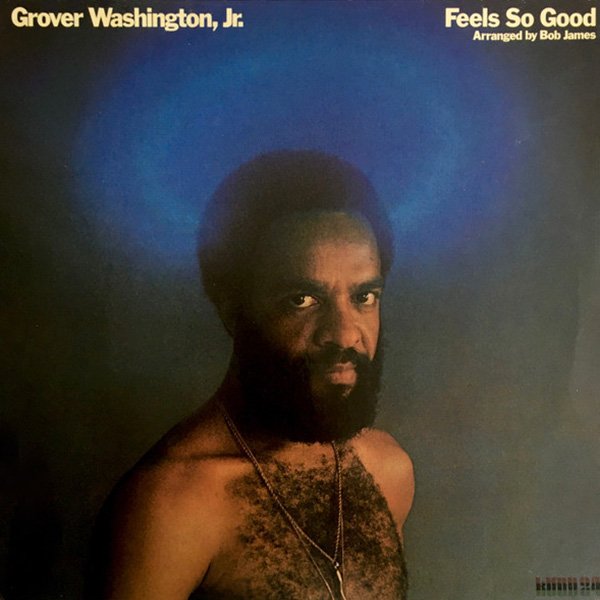
Feels So Good
The tenor and soprano sax player’s Creed Taylor-produced, Bob James-arranged 1975 jazzfunk/fusion album might just be his peak album. It has been sampled extensively, due to its impeccably played and pristinely recorded drums, and a production aesthetic that at times was sparse, uncluttered and lean with lots of space — perfect for sampling from. Feels So Good showcases the three different moods of Grover Washington Jr.: opener “The Sea Lion” is a fast-tempoed, twitchy jazz funker, intricate and spacey then suddenly slick and classy, while “Moonstreams” is six minutes of beatless, drifting, shifting meditative jazz, its pretty and unassuming character a clear hint of the more commercial direction of his post-Kudu releases. For the rest of the album, across three lengthy songs, it’s classic mid-seventies GWJ: in the pocket, slickly funky grooves that switch between deluxe ensemble main themes, and perfectly constructed funk vamps for soloing. Impressive, super tight playing, highly polished, multi-layer grooves and those drums, easily one of his strongest efforts, with a sound that’s dated well.
One of the catches to the whole concept of “smooth jazz” is that sometimes its practitioners will back-burner any notions of audio-wallpaper propriety — and, if you’re lucky, they instead just lean headlong into some idiosyncratic idea of opulence that’s more energetic than polite. Grover Washington, Jr.’s mid-seventies crossover-smash era had a long lead time — his collaborations with arranger/producer/smooth-fusion figurehead Bob James date back to his sessions for 1971’s bandleader-debut Inner City Blues — so by the time he’s helming Feels So Good he’s got this natural-as-breathing ease to his soprano and tenor sax playing that still allows for a lot of rangy and surprising moments of expressiveness. “Knucklehead” and “Hydra” are cratedigger favorites for good reason, the juxtaposition of their funky elastic bounce and the rich orchestral depth evoking street-level cool and penthouse sophistication all at once (with the respective basslines of Gary King and Louis “Thunder Thumbs” Johnson providing a monster of a structure for Washington to melodically banter with). And while Washington’s technique does a good deal to embody the duality that comes with working in soul-jazz crossover — the oomph of a Maceo Parker to go with the improvisational flow of a Cannonball Adderley — Bob James’ arrangements do just as much to answer that call as, say, Quincy Jones’ soundtrack work, piling on the strings in ways that simultaneously evoke bygone big-band swagger and post-blaxploitation suspense-flick bombast.
Recommended by
![3 Days of the Condor [Original Soundtrack] cover](https://images.theshfl.com/5660811997741056_600.jpg)